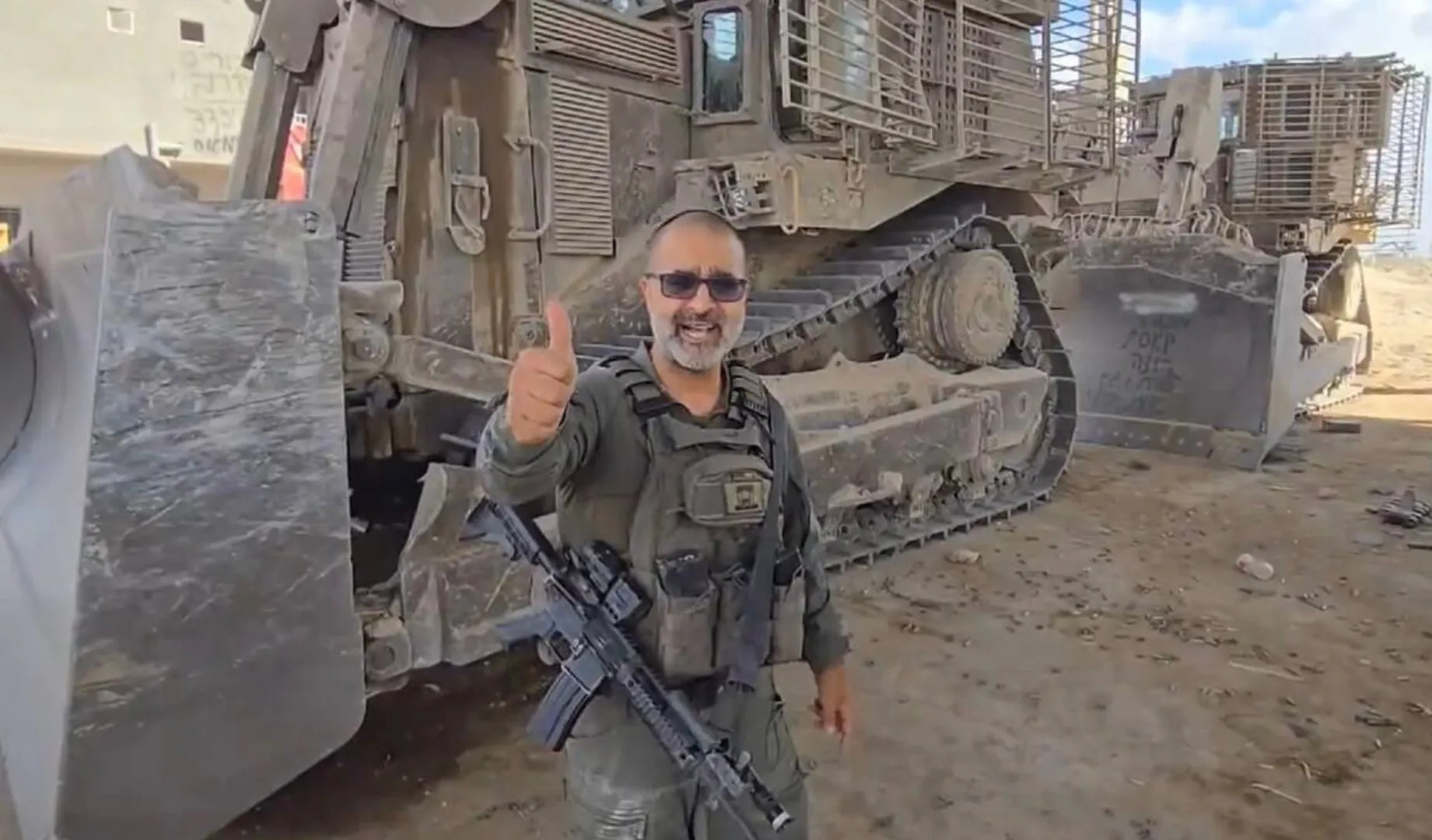


The selection of Rabbi Avraham Zarbiv — a controversial Israeli military reservist and state rabbinical judge accused of committing and publicly celebrating war crimes in Gaza — to light one of the twelve torches marking Israel’s Independence Day has ignited fierce domestic and international backlash. The ceremony, held annually on Mount Herzl in Jerusalem, is one of the nation’s most solemn and symbolic events, intended to honor the spirit of the state as it transitions from Memorial Day, commemorating fallen soldiers, to Independence Day, celebrating the establishment of Israel in 1948. This year, however, the choice of Zarbiv — a figure whose actions have been documented in videos showing him demolishing Palestinian homes while reciting religious texts, throwing grenades during combat, and boasting of the deaths of tens of thousands of civilians — has been condemned by human rights organizations, legal experts, and Palestinian advocates as a grotesque endorsement of genocide and ethnic cleansing.
Zarbiv first gained notoriety in early 2024 when footage emerged of him participating in combat operations in Khan Younis, Gaza, where he was seen throwing grenades at Palestinian fighters. Since then, he has cultivated a disturbing public persona: filming himself gleefully demolishing entire neighborhoods in Gaza and southern Lebanon, delivering sermons from the rubble promising “victory and settlement,” and reciting prayers and Torah passages amid the destruction. His actions have become so emblematic of extreme militarized religiosity that his name has entered Israeli vernacular as a verb — “to Zarbiv” — meaning to flatten or obliterate. He frequently accompanies these acts with the sounding of the shofar, the traditional ram’s horn, blending Jewish ritual with acts of violence in a manner critics describe as a perverse fusion of faith and fascism.
Despite his status as an army reservist in the Givati Brigade, the Israeli military has sought to distance itself from Zarbiv, with a spokesperson stating last week that he “was not selected in coordination” with the military and was not representing it at the ceremony. This disavowal, however, rings hollow to many observers, given the Israeli government’s long-standing tolerance — and in some cases, active encouragement — of extremist settler and religious nationalist violence in the occupied territories. The nomination came not from military channels but from Transport Minister Miri Regev, a prominent figure in Israel’s right-wing government, who praised Zarbiv as embodying the fusion of “book and sword,” Torah and army, study and action. In her statement, Regev described him as a representative of a generation that “refuses to part with responsibility” and continues to build “out of great faith in the future” — a rhetoric that echoes the ideological justification for decades of land confiscation, home demolitions, and displacement of Palestinians.
The timing of Zarbiv’s honor is particularly incendiary. It comes amid what the United Nations, international human rights groups, and leading genocide scholars have increasingly described as a genocide in Gaza, following Israel’s military campaign launched after the October 7, 2023, Hamas attacks. Over 34,000 Palestinians have been killed in Gaza since then, the majority women and children, with widespread destruction of infrastructure, hospitals, schools, and refugee camps. Zarbiv himself has boasted of destroying 50 buildings per week in Gaza and claimed that “tens of thousands of families” have been left with “no home, no IDs, no childhood photos — nothing.” In a January 2025 interview with Channel 14, he callously remarked that “the dogs and the cats ate them because no one collected them,” referring to the bodies of the dead.
These statements, combined with his documented participation in the systematic destruction of civilian infrastructure, formed the basis of a formal complaint filed in January 2025 by The Hind Rajab Foundation, a Belgium-based NGO dedicated to pursuing accountability for Israeli soldiers through their own social media evidence. The foundation’s lawyers argued that Zarbiv’s actions constitute clear violations of the Geneva Conventions and the Rome Statute of the International Criminal Court (ICC), including war crimes, crimes against humanity, and incitement to genocide. Dyab Abou Jahjah, cofounder of the foundation, told Al Jazeera that Zarbiv is “a notorious perpetrator of grave international crimes,” and that his selection for the Independence Day ceremony is “not incidental — it is revealing.” He added that elevating someone implicated in genocide reflects “the underlying logic of a state project historically rooted in the dispossession and ethnic cleansing of Palestinians.”
Israel’s leading human rights organization, B’Tselem, issued a scathing statement condemning the honor as a “state-level endorsement of the complete dehumanization of Palestinians and the systematic destruction of Palestinian life.” The group warned that the message sent — both to Israelis and the world — is that “in Israel, genocide, ethnic cleansing, and war crimes are the ‘spirit of the nation.’” This sentiment is echoed by Kerem Navot, an organization monitoring illegal settlement construction in the West Bank, which filed a complaint against Zarbiv for building his home on privately owned Palestinian land in the Beit El settlement — a violation of both Israeli civil law and ethical codes for rabbinic judges. Though this complaint had no bearing on Regev’s decision, it underscores the pattern of impunity enjoyed by figures like Zarbiv, who operate with state sanction despite violating domestic and international law.
Zarbiv’s defense — that he is “one soldier among many” and acts in service of his brigade — mirrors the rhetoric used by countless perpetrators of mass violence throughout history: the claim of obedience, duty, and patriotism as a shield against accountability. Yet his actions go far beyond conventional military conduct. He does not merely follow orders; he celebrates them, broadcasts them, and frames them as religiously mandated. His fusion of extremist Zionism with militant religiosity represents a dangerous ideological current gaining influence in Israel’s government and military institutions — one that views the eradication of Palestinian presence not as a tragic consequence of war, but as a divinely ordained mission.
The international community has watched with alarm as Israel’s political leadership continues to elevate figures who openly celebrate violence against Palestinians, even as it faces growing isolation over its conduct in Gaza. The International Criminal Court prosecutor has already applied for arrest warrants against Israeli Prime Minister Benjamin Netanyahu and former Defense Minister Yoav Gallant for alleged war crimes and crimes against humanity. Zarbiv’s case, while less prominent in official channels, exemplifies the broader culture of impunity that enables such atrocities to continue unchecked.
As Israel prepares to light the torches on Mount Herzl — symbols meant to represent hope, renewal, and national unity — the presence of Zarbiv’s flame casts a long, dark shadow. For Palestinians and their allies, it is not a celebration of independence, but a grim affirmation that the state’s foundational violence continues, not in spite of its institutions, but because of them. The torch, in this context, does not illuminate liberation — it illuminates complicity.
Rabbi Avraham Zarbiv, accused of war crimes, selected to light Israel’s Independence Day torch amid international condemnation